
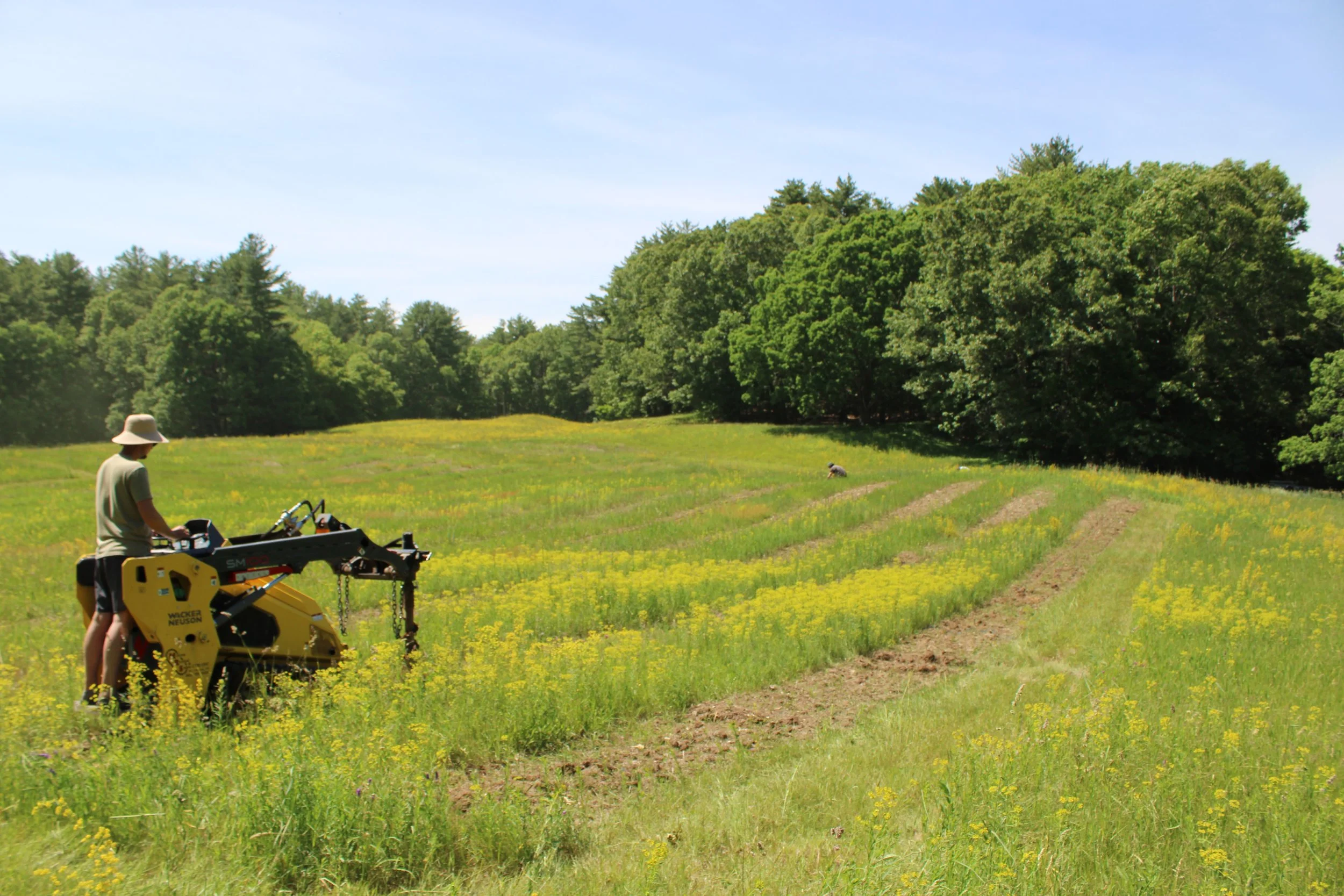
In partnership with our friends at VT Vineyards, we’re planting Massachusetts’ first regeneratively farmed vineyard over the spring of 2026, 2027, & 2028 at Whittier Birthplace in Haverhill, featuring a test plot of 55 carefully selected, unique vinifera clones & hybrid varieties. Stay tuned for further updates though our main Instagram page + newsletter. Once vines are in the ground, we’ll be offering tours & events + have volunteer opportunities to get involved with harvest & more.
Our Varieties
We’ve selected our test plot clones with a focus on obscure vinifera & new hybrids that show strong potential with our growing conditions, but that are not widely planted + those that prove cost prohibitive to procure. We expect to have only a handful of cases produced from each variety in most cases once in peak production! Grape vines take three years to produce a first crop, so unfortunately, you’re going to have to wait until 2029/2030 to try wine from the new vineyard.
Vinifera—The grape species traditionally used for quality wines over the past several thousand years, originally from the Caucasus. Unfortunately prone to fungal disease and quite challenging to grow more sustainably.
Hybrids—Natural crosses of Vitis vinifera with other species of grape that offer enhanced disease resistance & cold hardiness while still producing great wine when well selected and grown + vinified with care, allowing for more sustainable growing practices and better yields in harsh climates.
Our Whittier-Merrimack Estate
-
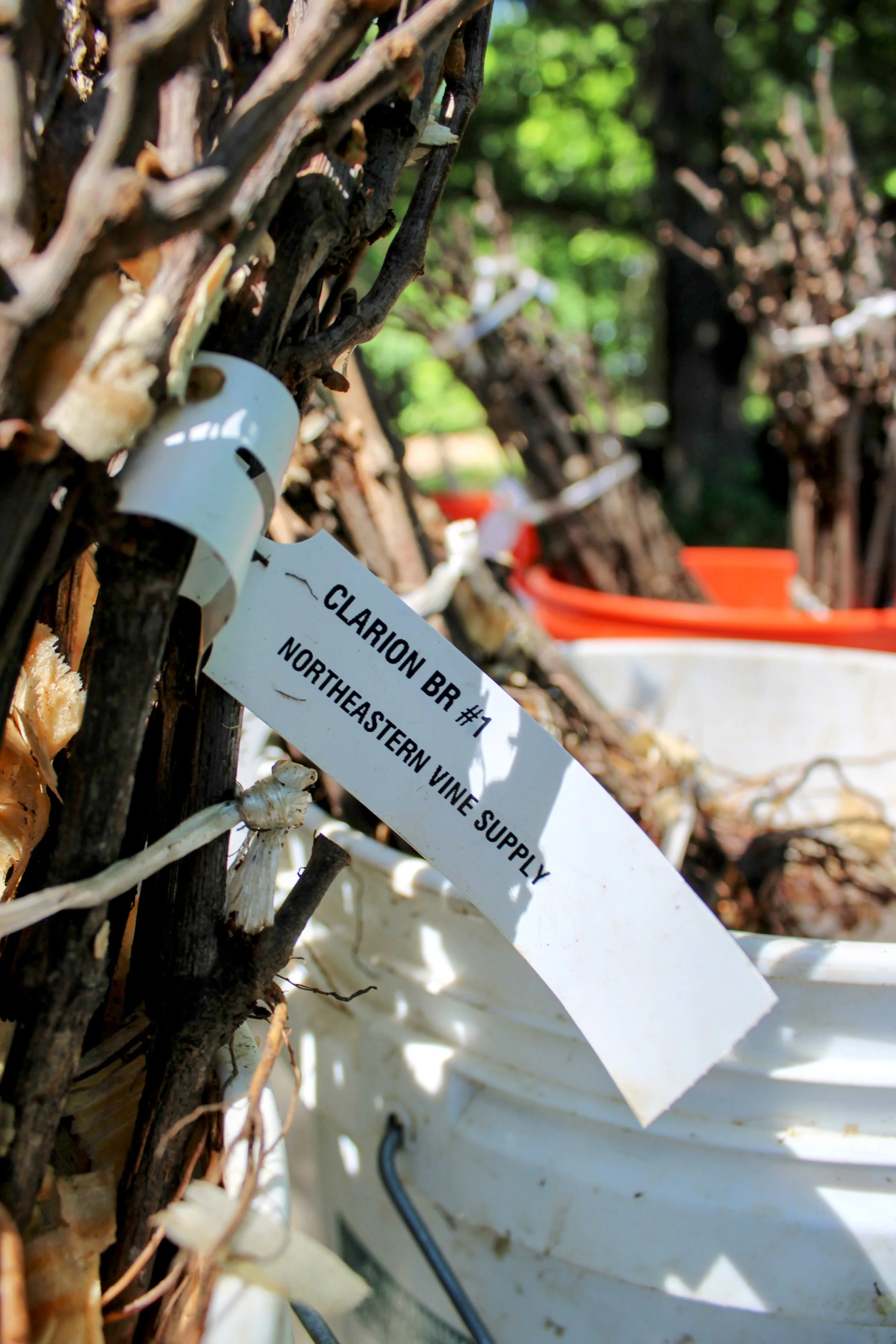
Clarion (2026)
A brand-new release from the University of Minnesota grape breeding program after 20 years of testing that supposedly makes great delicate and balanced white wine, so we’re looking forward to trying it for ourselves (there was a bit from VT in the great 2024 P. strobus)!
Prarie Star (2026)
Prairie Star may be our least favorite name for a grape variety, but it makes some fabulous wine. It produces much more full body, rich white wines than what typically comes out of cool and cold climates.
Louise Swenson (2026)
An unfortunately light bodied, yet citrusy and beautifully aromatic hybrid variety that may not have star power but blends wonderfully—quite similar to Kerner or Welschriesling in many respects.
Muscaris (2027)
A muscat type hybrid from Germany selected for its disease resistance and hardiness. We don’t know a whole lot about it beyond it’s been used to make some well-regarded wines in Poland of all places, but anything muscat excites us!
Johanniter (2026)
Another German hybrid new to the US that’s supposed to make excellent alpine style white wines (with tasting notes similar to Riesling, Pinot Blanc, Pinot Gris, etc.).
Aromella (2026)
A muscat type hybrid from Cornell that leans tropical thanks to its Traminette parent and tends towards grapefruity with earlier harvest & less skin contact. Unlike other muscat varieties, Aromella’s floral aromatics come out over time in the cellar rather than being notable in the fresh fruit, making it a fun surprise to work with. Our main grower in the finger lakes has some, but it ripens there before anything else and is loved by the birds, so it’s proven difficult to actually get our hands on the fruit, so we figured we should try growing it ourselves!
Aravelle (2026)
A long-awaited release from Cornell University—Aravelle is the result of a Riesling and Cayuga White cross in the 80s that’s supposedly got the best of both of its parents and then some, so we’re excited to see what we can do with it seeing as its parents are already two of our favorite grapes!
Sauvignon Rytos (2026)
An experimental new PIWI selection with reportedly similar characteristics to Sauv Blanc.
Calardis Blanc (2027)
One of our most experimental selections we know quite little about. It’s a very new PIWI (European hybrid) white variety that’s shown promise of producing top quality citrus-y white wines.
Floreal (2027)
One of our most experimental selections we know quite little about. A muscat-type new PIWI hybrid from France (we’ve got high hopes since the French are notoriously anti-hybrid).
Hibernal (2027)
A highly-regarded, balanced, well structured, and complex sounding German PIWI hybrid we look forward to trying!
Solaris (2027)
One of the most popular new PIWI hybrids in Europe— Veryyyyy similar to top quality Sauvignon Blanc.
Fleurtai (2027)
One of our most experimental selections we know quite little about. It’s a very new PIWI (European hybrid) resulting from a cross of Friulano that’s produced some excellent early wines.
Soreli (2027)
One of our most experimental selections we know quite little about. It’s a very new PIWI (European hybrid) resulting from a cross of Friulano that’s produced some excellent early wines.
Sauvignier Gris (2028/2029)
Considered the gold standard of the European PiWi (fungal resistant hybrid) varieties, we’re first in line to get vines once it’s through its US import quarantine/analysis/treatment period in California. It produces similar-to-superior wines as Pinot Gris.
-
Furmint (2027)
With our cold winters and hot, humid summers, we naturally look to central/eastern Europe and the Balkans for what vinifera varieties do well. Furmint is one of our favorite white grapes. Only widely grown in Hungary where it’s most famously used for Tokaji dessert wines, we’ll be one of the first US plantings we’re aware of. It makes super exciting dry white wines as well—think of it as Riesling’s edgier sibling.
Skrlet (2026)
To our knowledge, we’ll be the first commercial domestic planting of this inland Croatian white grape variety that produces some excellent crispy, savory white wines.
Rkatsiteli (2026)
A Georgian variety best known for traditional qvevri amber wines, it’s got an exciting spice character to it, and luckily for us, seems to grow great in the Northeast!
Welschriesling (2026)
No relation to regular Riesling, it’s widely grown by its Germanic name in central Europe and by the name Grassevina in Croatia. We’re not aware of anyone growing it domestically though—probably because it’s not historically known to be as exciting as other alpine varieties. It blends well though and really shines with skin contact and in pet nats.
Ortega (2026)
Quite common in England, where we were introduced to this variety, but very rare to come across anywhere else (well there’s apparently some in BC too). We find it to be a bit more delicate than other muscat varieties. Think more ripe melon & peach than floral bouquet aromatics and more lemon zest than orange marmalade for citrus. Like a lower acid, more bodied Kerner.
Auxerrois (2026)
Not particularly well known, in part because it’s so often blended with Pinot Blanc in Alsace that the varieties have been known to be confused for one another on occasion. The reason for often being found with Pinot Blanc rather than on its own is that while it’s a less exciting grape on its own, it excels where other cool climate grapes falter—it’s low in acidity and has more body, making it a great blending partner.
Riesling Clone 239 (2026)
Riesling clones can go in a couple different directions–more notes of honey, apple, and petrol; or more notes of citrus, tropical fruit, and minerality…We’re more interested in the latter personally and have chosen our clone accordingly. We can’t wait to see what kinds of zippy, dry patio pounders we get out of it!
Kerner (2027)
Appreciated by growers for being hardier and more disease resistant than most vinifera grapes. Like a slightly lighter body, more muscat version of Riesling. Not historically synonymous with fine wine, we love what Central European producers have been doing with it in recent years with some skin contact and as a field blend component, and are very excited to work with it. We look forward to being one of the few plantings outside of Germany.
Garan Dmak (2027)
Again, we believe ourselves to be the first to plant this grape commercially in the US, having had to source clonal tissue directly from FPS at UC Davis (the official overseer of properly imported & quarantined/treated grapevines in the US). It’s a rare cool climate full bodied white variety native to Armenia that can make exceptional wines.
Petit Manseng (2027)
A not-super-well-known Franch/Basque grape, traditionally blended or made off dry because of its high acidity. Interestingly enough, pioneering producers in Virginia & Mid-Atlantic have shown that it holds up well for late harvest despite our humid climate, and can produce exceptionally complex and delicious wines. Small berries mean small yields but concentrated flavors—think of some of the best characteristics of Pinot Gris and Chardonnay with some extra spice and zest.
Alvarinho (2027)
You know it, you love it, and there’s reason to believe it’s pretty well suited to our climate from some great examples coming out of the mid-Atlantic. Known for crispy, mineral white wines in Portugal & Spain, it does better than many vinifera varieties in humidity because of loose clusters and thick skins. However, those thick skins are also known to mean low yields in the winery which means don’t expect much produced from these vines and high prices (we think it’ll be worth it though!)
Mtsvane Kakhuri (2027)
A popular Georgian variety that excells in crisp light wine styles & oxidative styles alike.
Kisi (2027)
Our favorite Georgian white grape variety, just now available for planting in the US. Well structured & brimming with orchard fruit charchteristics, we can’t wait to see what we can do with it!
Khatun Kharji (2027)
A prized Armenian white variety with characteristics not dis-similar from crisper, more delicate expressions of Chardonnay.
Gruner Veltliner Clone 3 (2027)
A favorite alpine white from Austria!
Chardonnay Clone 15 “Prosser” (2027)
Many vinifera clones historically planted on the East Coast have been Burgundian selections, chosen for their mass market familiarity/going after wine styles that aren’t necessarily the right fit for our region. Instead of going down the same path, we’re planting a clone known to a) be more disease resistant than more common clonal selections, and b) being well suited to making fresh, mineral-driven, Chablis-esque expressions of Chardonnay.
Pinot Blanc Clone 9.1 (2027)
Pinot Blanc doesn’t have a huge following in the US, but is highly regarded in Europe. It’s a quite neutral, well-balanced white that, like Pinot Gris, is a mutation of Pinot Noir. It makes for creamy, delicate sparkling wines and is a great blending companion in still wines. Like many of our vinifera choices, clone 9 is selected for its improved disease resistance.
Pinot Gris Clone 457 (2027)
We’re not after cookie cutter mass produced Pinot Grigio…we’re much more interested in the exciting unconventional takes coming out of Alsace, Northeast Italy & Slovenia, and even Oregon. We also want a climate & regenerative agriculture sensitive selection. We’ve gone with clonal selection known for looser clusters & thicker skins (i.e. better resistance to fungal disease) and its full bodied, spicy, and complex flavors we think will make the most out of our growing conditions and vinification preferences despite being an unusual clonal selection around here.
Petite Arvine (2027)
A very highly regarded, centuries old indigenous Swiss white variety that’s not widely planted elsewhere. It’s also known to be quite temperamental. This one’s a bit of a shot in the dark, but our curiosity's got the best of us.
Sauvignon Blanc Clone 27 “Musque” (2027)
Many people are most familiar with New Zealand Sauv Blanc and other very conventional expressions of the variety that lean into its herbaceousness. We’re more interested in the much more aromatic and mineral-driven skin contact expressions of Sauv Blanc that come out of Austria & elsewhere in Central Europe. We’ve selected a clone that’s sometimes labelled under a completely different name, Sauvignon Musque, because of its much more muscat, tropical fruit notes and lower herbaceousness than other Sauv Blanc clones.
-
Verona (2026)
A grape we’ve wanted to plant since the earliest iterations of our plan to start Marzae—a stunning new Minnesota bred red grape with a bit of a paradox: despite being one of the most cold-hardy varieties in existence, it doesn’t ripen in most cold climates! Our growing season is pretty much the shortest you can plant and reliably ripen Verona. It’s also a fascinating grape to work with—fresh it tastes like actual artificial grape candy, not like something that would make fine wine. It’s the inkiest grape we’ve ever encountered (yes, far more purple than the famed teinturier Saperavi) and has a deep balsamic-y depth while keeping fresh and fruity.
Crimson Pearl (2026)
Frankly, we don’t know a ton about crimson pearl (hence the small planting), in part because its release was overshadowed by its sibling petite pearl that offers the depth so many cool climate reds lack. Crimson pearl’s much lighter fruit on the other hand sounds like the makings of some great lighter reds & roses.
Petite Pearl (2026)
The most well-known grape from the same breeder as Verona, Crimson Pearl, and T.P. 1-1-12, petite pearl is often blended with Marquette to add additional depth of color and flavor, but also brings delightful black raspberry fruitiness to the party.
Gamaret (2026)
We love Gamay, but it’s got an Achilles heel that makes it quite risky to grow in a cold climate—it buds very early, making it much more likely to fall victim to a late spring frost (maybe you’ve seen pictures of vineyards in Beaujolais with fires going amongst the vines at night in the spring?). Well, the Swiss (yeah, apparently, they grow some wine in Switzerland!) developed Gamaret as the answer for a hardier version of Gamay. Gamay is a full parent of Gamaret, and they share many similarities quality wise, but Gamaret has all of the desirable hardiness & disease resistance characteristics of hybrids! We’ve never actually tried wine made from Gamaret because it’s almost exclusively grown in Switzerland so are super excited to see what it does here.
Resiliance (2026)
A not quite fully released new red variety from the same breeder as Verona, Crimson Pearl, and Petite Pearl…this one’s kind of a shot in the dark but excited to see what it does!
Veritage (2027?)
A not quite fully released new red variety from the same breeder as Verona, Crimson Pearl, and Petite Pearl…this one’s kind of a shot in the dark but excited to see what it does!
Merlot Kanthus (2028?)
One of our most experimental selections we know quite little about. It’s a very new PIWI (European hybrid) red variety that’s shown promise of producing top quality red wines.
Cabernet Cortis (2027)
One of our most experimental selections we know quite little about. It’s a very new PIWI (European hybrid) red variety that’s shown promise of producing top quality red wines.
Chambourcin (2027)
One of the original French red hybrids from the early 20th century, but quite experimental for us climatically. Chambourcin requires a very long growing season relative to what’s typical of regions planting hybrid grapes (beyond even Verona), meaning many examples of what’s available on the market aren’t great showcases of what it can taste like because they lean under-ripe (which not only can fall flat on ripe fruit character, but have herbaceous notes common in Cabernet Franc). Ripe, Chambourcin can produce top tier reds that are full of forest fruit notes, cola, and bordeaux blend-like depth and sophistication.
-
Turan (2026)
A teinturier or red-fleshed grape from Hungary. Not widely planted outside of Hungary, we don’t really know what we’re going to be able to do with it but are excited to find out!
Saperavi (2026)
The Republic of Georgia’s famous red teinturier (or red fleshed) grape variety. It thrives in cool climates and produces much more balanced and structured red wines than most other cool climate red varieties, hence the growth of interest in the variety in the Finger Lakes and beyond. We do currently have a source of great quality fruit, but they’re both further away and more conventionally grown than we’d like so we’re hopeful of how Saperavi will perform on our site (its quality is very sensitive to terroir).
Pinot Meunier Clone 01 & 06 (2026)
Most famously used in champaign, it can also make some exceptional varietal wines when grown well and treated right in the winery.
Corvina Veronese (2026)
A grape almost exclusively grown in northeastern Italy where it’s most famously made into a full-bodied wine with partially dried berries (which won’t be happening here thanks to our humid climate), it makes exciting tart, juicy wines not dis-similar from Gamay fresh.
Lagrein (2026)
A robust, sophisticated red variety sharing lineage with Syrah and Pinot Noir from the Dolomite region of Italy bordering Switzerland. Like Verona, it’s got a lot of potential in cooler climates but requires a long growing season and warmth during ripening relative to what’s found in many cool climates. It’s also apparently a bit finicky to grow and doesn’t always have great yields, helping explain why it’s not as widely grown despite the quality of wine it produces.
Pinot Noir Clone 2A “Wadenswil” (2026)
Many vinifera clones historically planted on the East Coast have been Burgundian selections, chosen for their mass market familiarity/going after wine styles that aren’t necessarily the right fit for our region. We’ve selected a Swiss-originated Pinot Noir clone with superior disease resistance, known to produce very lively, yet complex expressions of pinot noir (we’re firm believers pinot noir is meant to be juicy and easy drinking, not masquerading as a full bodied red).
Danakharuli (2027)
A lesser-known Georgian red grape variety that can make excellent wines bursting with juicy red fruit. We got this genetic material from FPS as well and believe it to be one of the first commercial plantings outside of Georgia period so can’t wait to see what it does!
Feteasca Neagra (2027)
We didn’t get this ordered in time for 2026 planting, so it’ll be a year behind everything else, but we’re excited to give it a go. It comes from Romania where it’s known to be hardier and easier to grow than many vinifera varieties while producing balanced dark fruit & smokey spice oriented wines.
Kadarka (2027)
An Eastern European gem, Kadarka makes medium bodied reds full of woodsy intrigue, red fruit, spice, and even enticing oxydative character.
Teroldego (2027)
Grown in a very specific region in Northern Italy, and by a handful of growers in the Northeast. It’s actually the parent variety of both Syrah and another obscure variety we grow, Lagrein. It’s known to be quite temperamental around harvest, with a tendency for the berries to drop off the vine in the wind and to develop bunch rot if it’s too wet, making it a risky grape to grow. Many find it worth the risk though because it can produce quite complex and pigmented reds relative to many other cold climate reds.
Refošk (2027)
A coastal Slovenian/Northeastern Italian red with big personality—plenty of color + tanins and acid.
Our Terroir
Physical Characteristics
Just over 1 hectare to be planted ultimately (~2.5 acres)
Hilly with SSE prevailing slope (except for a couple NNW rows we’ll be planting hybrids on in 2027)
Near sea level elevation (113-145ft)
Soil
Deep, loamy sand comprised of glacially deposited gneiss/granite/schist
Calgranofel bedrock
pH naturally 5.5-6 on average (rarely basic for typically acidic Eastern MA soils, which is necessary for vine nutrient uptake)
Approx. 3% average soil organic matter
Climate
Approx. avg. 2800 GDD Fahrenheit (~1500-1600 C) with 193 day growing season
Average low around 20F (~-7C) w/ temps below 6F statistically unlikely
Hot-summer humid continental climate classification (fun fact—humidity is our #1 challenge, not the cold!)
History
Pennacook land prior to the founding of Haverhill.
First established as a farm homestead in 1688 and used in various agricultural capacities since, with our planting being the first significant agricultural use beyond haying in decades.
Birthplace of 19th century poet & abolitionist John Greenleaf Whittier.
Our Growing Practices
You may be more familiar with terms like organic & biodynamic for growing grapes, but we favor “regenerative” viticulture, which actually goes above and beyond organic standards. We encourage you to read on to learn about what “regenerative” means to us since there is no standard definition:
Dry farming (new planting/extreme drought aside) to reduce reliance on limited freshwater sources
We’re able to avoid the need for irrigation even on our well drained sandy soils by building soil organic matter to preserve moisture for grape vine roots to seek out in periods of low rain
No petroleum derived fertilizers
Grapevines don’t need huge amounts of fertilizer to begin with and providing organic nutrient sources that are less bioavailable actually helps wine quality!
We’ve got our own compost utilizing local wood chips, clam shells, grape pomace, & more + plan on grazing ducks beginning 2028 which provide further nutrients through urine and feces.
No herbicides + No insecticides unless absolutely necessary, focusing on other means of control (IPM)
There’s no excuse to use cancer causing chemicals to kill weeds, especially when it comes to growing grapes, for which there are many simple physical means of preventing potentially problematic vegetative growth under vines from weed-whackers and hand pulling, to mowing, rolling/crimping, and grazing…this is our biggest frustration sourcing grapes as “sustainable growing programs” still allow for the use of glyphosate! We’re even planning on integrating grazing ducks to help manage vegetation without even having to use electricity.
Insecticides are well known to pose ecological risks as well, particularly to bee/beneficial pollinator populations, and can generally be avoided with various cultural practices and biologics. We plan to closely monitor pest pressures and respond with the least harmful, and ecologically-focused control methods implemented first (including working with birds & beneficial insects and carefully managing cover crop & surrounding plant species). Our ducks will also help out here! Really bad pest pressure can prevent grapes from ripening and cause permanent vine damage though, so it’s important we keep our options open in a worst case scenario (such as a spotted lantern fly, sharpshooter (the source of an irreversible vine disease), or Japanese beetle infestation).
If IPM/Cultural/Biologic pest controls fail to keep damage to manageable levels, the organic insecticide Pyganic 5.0 is used (a chrysanthemum derived compound that rapidly breaks down in sunlight once used to knock back problematic insects with targeted hand spraying to minimize potential harm to beneficial insects).

No-till farming with polyculture cover crops promoting native species
We aim to do our part to support native bee populations and otherwise support ecosystem restoration, while building healthy soils and resilience.
No till farming practices allow us to build soil carbon, which enables net carbon negative farming through sequestration, enhances soil water retention, and improves soil fungal & insect ecology.
Over time we plan to seed native species to bolster habitat for native species.
Culturally minimized reliance on fungicides, utilizing a rotation of non-copper organic bio fungicides
Our big gripe with “organic” grape farming is it typically means fungal disease pressure devastates yields in humid climates like ours (a few super resistant hybrid varieties aside), and/or it means the vineyard is spraying a bunch of copper to prevent mildew outbreaks (copper is an “organic” fungicide that permanently accumulates in soil as a heavy metal, killing microbes & insects).
We’re picking varieties, planting parameters, and growing practices that are best suited to our growing conditions to minimize disease pressure.
To manage persistent disease pressure to economically tolerable levels, we’ll use very targeted sprays of a strategic rotation of organic biofungicides (essentially plant pro-biotics, plant-derived immunity boosters, and organic compounds like hydrogen peroxide). Typically in high pressure climates like ours, these are used in conjunction with conventional fungicides for maximum efficacy, but the most effective such fungicides are well known to pose hazards to invertibrates/aquatic life and human health. However, newer generations of biofungicides have proven more effective, and we have such a strong focus on rigorous cultural management practices we’re going to grow even the vinifera varieties 100% organic. We’re going to begin spraying in our vines’ second year (a whole year before they’ll produce their first crop) to try to prevent disease from even gaining a foothold in our new site.
We invite you to learn about our spray program here.
Quality > Quantity & Cost (our biggest challenge when buying grapes since growers get paid by the ton and thus tend to overcrop and cut out labor wherever possible, relying on carbon intensive and less-than-ideal-for-quality heavy machinery)
Hand pruned, sprayed, weeded (with the help of our ducks), & harvested
Optimally ripened & not over-cropped – “vine balance” + cluster, shoot, & leaf thinning where necessary
Carefully chosen site, varieties, row placement, & management practices

Our Sheffield-Berkshires Restoration Vineyard
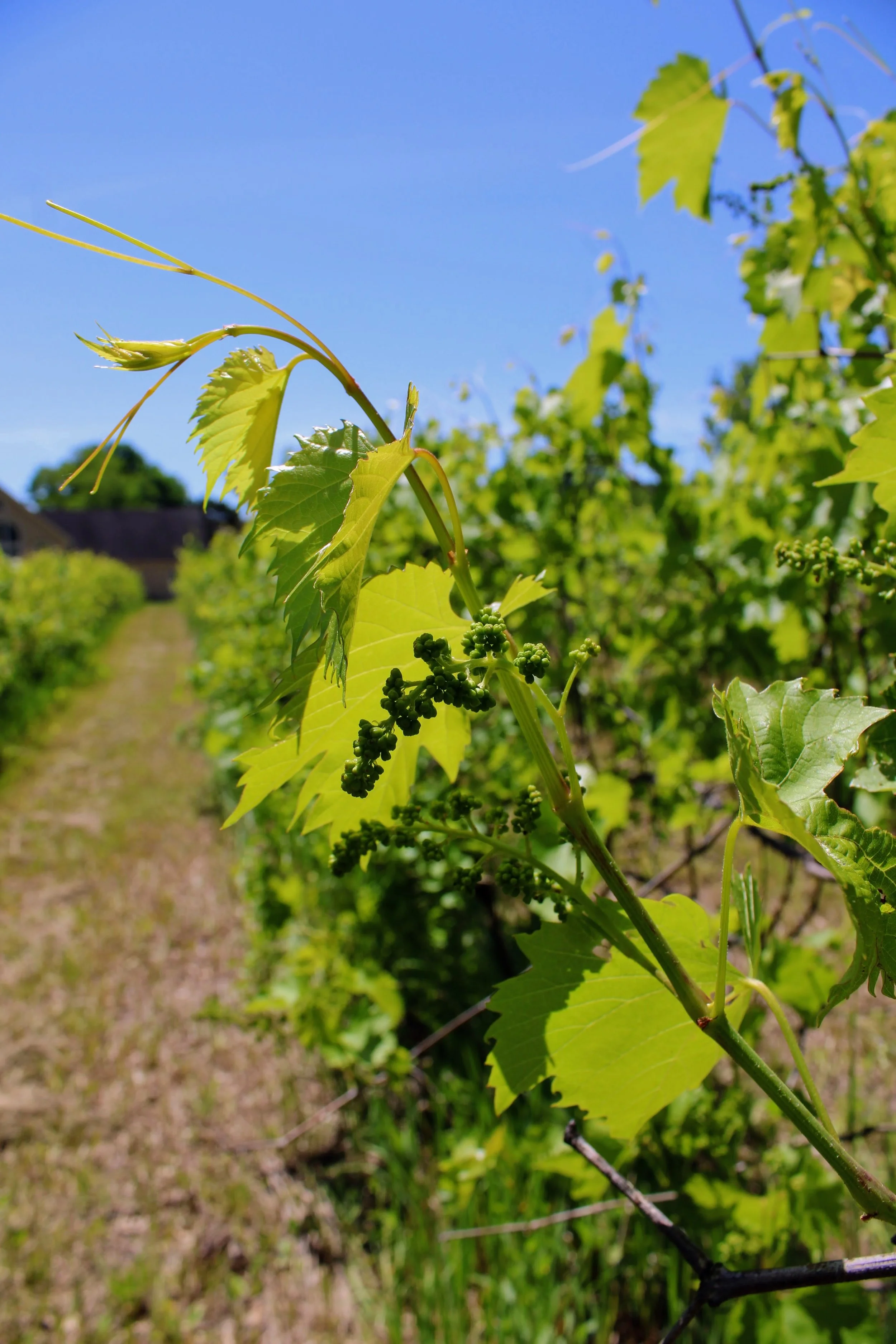
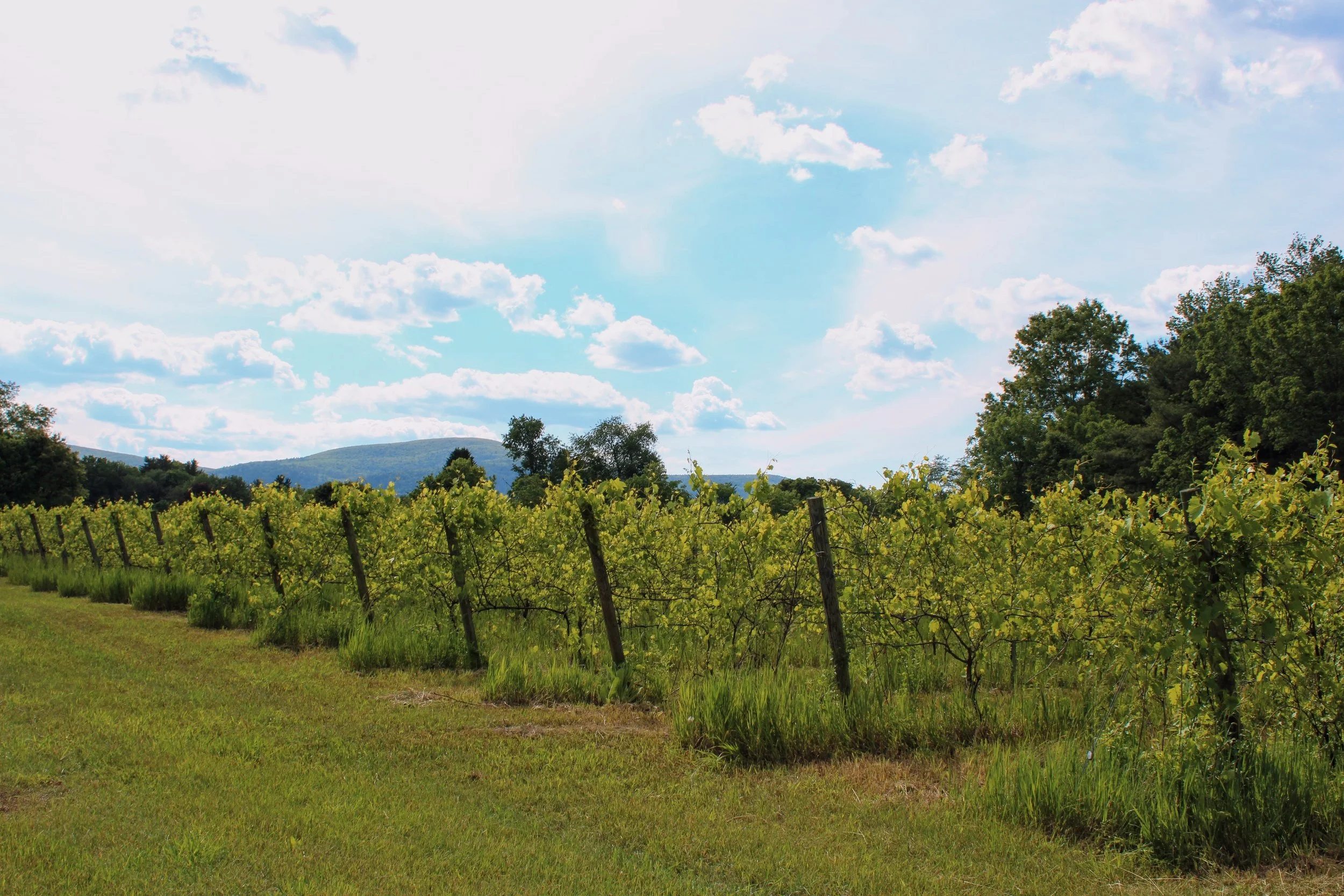
June of 2026, we took over management of an abandoned vineyard site of approximately 1.2 acres in the Berkshires. We’re currently in the process of remedial prunning and cleanup work with the help of generous friends. Organically farmed Frontenac Noir & Frontenac Gris from this site will be utilized in our 2026 production (and we’ve got extra Frontenac Noir available for purchase!). Because the site is so far away and is heavy cropping with varieties that are tricky to put to use in large quantities (i.e. we can afford to loose a decent amount of the crop), we’ve decided to manage it largely no-spray/a much more hands off take on our home vineyard practices.
Learn more about our partner vineyards & additional varieties we work with
Lesser known varieties we buy but don’t grow:
Blaufrankisch–A Central European workhorse that’s in most of our red wines. Probably best described as somewhere between Gamay & Pinot Noir in flavor and character.
Marquette–The current gold standard for red hybrid varieties. It’s an offspring of Pinot Noir and shares similar fruity character to Blaufrankisch, with perhaps a bit less spicy depth.
Seyval Blanc–One of the original French hybrids from the early 20th century with excellent Chablis-like flavors & complexity. Its achilles heel is its very light body, making it better suited to blending than use as a varietal.
Vidal Blanc–Another of the original French hybrids with the opposite problem as Seyval…it’s not the most exciting tasting but is quite balanced and has decent structure, again, making it a better blending component than varietal wine. We’ve discovered it really shines with skin contact though.
Valvin Muscat–A very punchy muscat hybrid that has flavors very reminiscent of Cascade hops.
La Crescent–One of our absolute favorite hybrids, but not the easiest to grow or work with. It’s got a quite distinct muscat character with skin contact…orange blossom/honeysuckle/stonefruit…but much more restrained and citrusy without skin contact. The problem is, it tends to borderline unpalatable levels of acidity, making it better suited for blends than varietals.
Cayuga White–Not a great name, but a gem of 20th century breeding. Cayuga is pretty neutral, well balanced, citrusy, and slightly mineral driven…not dissimilar to Pinot Blanc in many regards. One of the few hybrids that stands as a varietal.
Arandell–A bold, finicky newer red hybrid from Cornell that packs a serious punch with its herbaceous cedar notes. We find it actually shines best as a rosé, delivering vibrant red cherry notes.
Our Vineyard Partners:
Lake Road Vineyard (Finger Lakes AVA)– Located on the East side of Lake Cayuga with West facing aspects, Lake Road is one of the few Finger Lakes growers that really cares about what they're applying in the vineyard to the same degree as our own operations…while many others in the Finger Lakes follow the bare minimum sustainable growing program requirements (which still allows for carcinogenic glyphosate and other very problematic-yet-legal sprays). They also work with varied clonal selections, treating them as the unique fruit they are.
Lieb Vineyard (Long Island AVA)– Located on the North Fork of Long Island, they too have long gone above and beyond sustainable growing standards, always utilizing mechanical weed control rather than herbicide. They've also got some of the oldest Pinot Blanc vines in the country, which we're putting to great use in a number of our wines.
Semelka Vineyard (Lake Erie AVA)– Located on the South shore of Lake Erie in the heart of table/juice grape country, Cortenay is growing some of the finest Saperavi we've ever tasted with a spray program again exceeding sustainable growing program standards.
Onabay Vineyard (Long Island AVA)– A sustainable passion project vineyard on Long Island growing some of the best Bordeaux varieties on the East Coast. If top notch more conventional single vineyard Bordeaux blend appeals to you, we highly recommend John's Leo Family Cellars label.
Doyle Keuka Lake Vineyards (Finger Lakes AVA)– Unfortunately the most conventional vineyard we source from, yet with excellent terroir. We've been working with them since 2024 to improve their growing practices beyond the minimum sustainable growing program standards. The vineyard sits East facing on the west shore of Keuka Lake, neighboring the esteemed Dr. Konstantin Frank winery. In 2024 we piloted improvements to their growing practices, eliminating the use of herbicides on a portion of their acreage.
Jacob Thomas Vineyard (Finger Lakes AVA)– Our sustainable growing program source for Gamay just down the road from our friends at Usonia in between Cayuga Lake and Seneca Lake.
Caywood Vineyard (Finger Lakes AVA)– Our source of Blaufrankisch & Vidal. Originally managed by Doyle, now Weis, it’s unfortunately conventional despite being part of the Finger Lakes Sustainable Growing Program. We’re working with Weis to improve the growing practices.
Airy Acres Vineyard (Finger Lakes AVA)– Our brand new sustainable growing program source of rkatsiteli.
Plus Various Small Organic Vineayrds Throughout Vermont